Wednesday, 30 November 2016

Up for Sale? Who is next


The container-shipping industry has been highly unprofitable over the past five years. Making things worse, earnings have been exceptionally volatile. Several factors are responsible, notably trade’s spotty recovery from the global financial crisis, and redoubled efforts by corporate customers to control costs. Some of the pain is self-inflicted: as in past cycles, the industry extrapolated the good times and foresaw an unsustainable rise in demand. It is now building capacity that appears will be unneeded.

These problems are real and significant, and largely beyond the power of any one company to address. But shipping companies cannot afford to throw up their hands and accept their fate.

These developments are leading to alliances, mergers, acquisitions & sale!
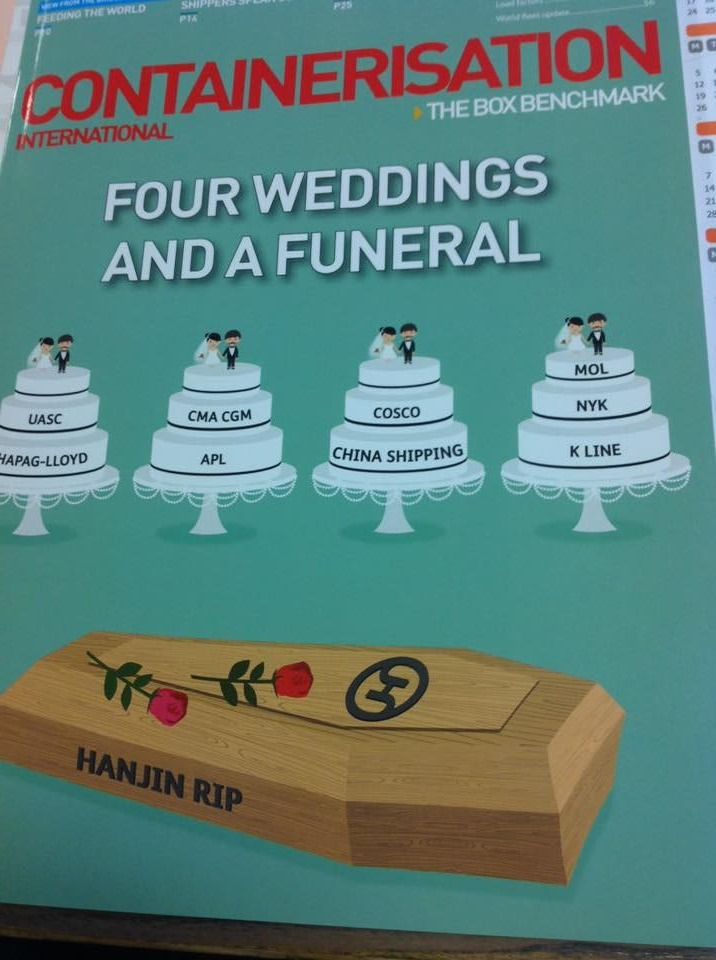
Latest in the race is Hamburg Süd. The owners of Hamburg Süd are tipped to opt for an outright sale rather than a merger. A sale of the Hamburg Süd by the family owners Oetker conglomerate, which runs the gamut from pizza and beer to financial services and shipping, would accelerate the consolidation that has significantly reshaped the financially troubled industry this year.

Who are the buyers?
On 1st December 2016 - Maersk Line and the Oetker Group have reached an agreement for Maersk Line to acquire Hamburg Süd, the German container shipping line. The acquisition is subject to final agreement and regulatory approvals.

Maersk CEO Soren Skou confirmed in September that Maersk Line is mulling acquisitions in its bid to grow in line with the market when he unveiled the group’s new strategy that will split its shipping, ports, and logistics operations from its energy division.

One company's loss is Another company's gain!
Hamburg-Süd has twice held merger talks with Hapag-Lloyd, most recently in 2012 and 2013, but the companies failed to agree on shares in an enlarged carrier. Hapag-Lloyd last week secured approval from the European Union for its takeover of United Arab Shipping Company.


Up for sale? Who is next?
Hamburg Süd, along with Orient Overseas Container Line, Yang Ming Line, Hyundai Merchant Marine, and Zim Integrated Shipping Services, are coming under increasing pressure to consolidate following a spate of merger and acquisition deals that have seen the market leaders pull ahead of mid-ranked carriers.


Hamburg Süd – as a line
Hamburg Süd has focused on north-south routes, particularly Latin America, where it strengthened its position with the $160 million acquisition of the container line services of Chile’s CCNI in 2015, and recently moved into the east-west market through a cooperation agreement with UASC.

The carrier operates a fleet of 116 ships — 44 owned and 72 chartered — with an aggregate capacity of 600,344 twenty-foot-equivalent units and a market share of 2.9 percent, according to industry analyst Alphaliner. It has eight ships of 30,400 TEUs on order.

The Hamburg-based line, which is also involved in bulk shipping and product tankers, boosted revenue by almost 17 percent in 2015 to just over 6 billion euros ($6.4 billion) driven by the acquisition of CCNI and its debut on the east-west liner trades. Container traffic last year was up 21.5 percent at 4.1 million TEUs.
Unlike the majority of its competitors, Hamburg Süd is not a member of an alliance. The company does not publish profit and loss figures.

Tuesday, 29 November 2016

J3 for shipping - from land of the rising sun


Japan’s big three shipping majors – NYK, K Line, have decided to end decades of fierce rivalry and merge their container shipping businesses into a new line ( a new joint-venture company ) with a total capacity of 1.4m TEUs , which would rank as the sixth largest in the world and have a global market share of approximately 7%.
J3 - Stronger together
.
When will J3 be operational?
The deal was subject to shareholders’ agreement and regulatory approval with a planned establishment of the new company scheduled for 1 July 2017, and the target for business commencement set for 1 April 2018.

What is in it for the shipping trade?
·         “J-3” will become the world’s sixth-largest container line, with the top seven lines controlling around 65 percent of the global liner capacity by 2018.
·         The J3 will operate a combined fleet of some 1.4million twenty-foot-equivalent units with a global market share of about 6.6 percent, based
·         J3’s JOINT order book totals 358,000 TEUs


Before J3 & After J3
According to vesselsvalue.com, NYK owns the largest container fleet, with 68 vessels providing a total capacity 507,046 teu, valued at $2.33bn; followed MOL, with 35 ships for 307,449 teu, valued at $1.7bn, and third K Line, which owns 31 containerships with a capacity of 240,440 teu and a value of $1.2bn.
It has been agreed that the shareholding of the container line joint venture will be: K Line 31%, MOL 31% and NYK 38%, with a total contribution of Y300bn, including fleets and share of terminals, but will exclude terminal operating business in Japan.
:

Why go for J3?
We will look at the reasons for J3 :
1.    Stability : The three Japanese companies have made efforts to cut cost and restructure their business, but there are limits to what can be accomplished individually. Under such circumstances, the 3 carriers have decided to integrate their container shipping business so that they can continue to deliver stably high quality and customer focused products to the market place.
In the past few years container liner shipping has been a problem child for all three of the Japanese trio as they have found themselves increasingly unable to match the economy of scale unit benefits enjoyed by the big three of Maersk Line, MSC and CMA CGM.

2.   J3 is part of THE Alliance: A factor in the decision to merge their container activities is that the Japanese carriers will all be members of the new THE Alliance east-west vessel sharing grouping from April next year, which makes the integration significantly less complex.
After the bankruptcy of Hanjin Shipping and the merging of the Japanese trio - THE Alliance will be streamlined into three carriers: Hapag-Lloyd, Yang Ming and the new Japan carrier J3 , thus overcoming the “too many cooks” criticism that has previously been levelled by analysts at the grouping.

3.     Japanese shipping majors share a Common corporate culture : Moreover, the Japanese shipping groups have a close relationship that stems from their “common corporate culture” with senior executives and operational management naturally familiar with their counterparts at the other companies.

4.      Competition’s M&A activity:  The container shipping industry witnessed a flurry of M&A activity in the past year – with of CMA CGM’s acquisition of NOL, Hapag-Lloyd’s merger with UASC, and the merging of the two Chinese state-owned lines – has widened the gap in this sector and proved a drag on consolidated group results for the Japanese companies.
According to Alphaliner data the merger of Hapag-Lloyd and UASC will lift the German carrier to fifth in the world rankings at 1,479,968 teu capacity, behind the merged Cosco and CSCL at 1,560,999 teu, with the proposed Japanese grouping taking the sixth spot with 1,369,728 teu.
Top Lines - in 2018?
Other facts: The three companies all operate portfolios of diversified enterprises that include: bulk shipping, car transportation, LNG, tankers, offshore, energy heavy lift and air cargo transportation.The three japanese majors have significant overlapping interests in terminals worldwide which may need to be rationalized.

Friday, 18 November 2016

3D Printing / Additive Manufacturing : Its Disruptive Impact on Supply Chain


Picture phones and hand-held mapping devices were once devices of the imagination until technology made them real. Now, we can add 3D printers to this list of inventions. 3D printers have a huge potential to bring revolutionary changes. 

3D printers have been around as huge, costly machines for three+ decades, advances in digital scanners and software now make 3D printers accessible tools that can design and create products that once required a factory and dozens of parts. In fact, 3D printers can make items that even traditional factories can’t. With 3D printing, it’s a whole new game. 

What Can 3D Printers DO for YOU?

We are just starting to see the worldwide impact of 3D printing which is also known as Additive Manufacturing. What could previously only be imagined can now be made in minutes. Need a car 3D printed - Yes you can do it! Need a custom-fitted prosthetic hand or hearing aid? Print it on a 3D printer. Stuck on a freighter in the middle of the ocean with a broken engine valve? Print a new one. Have an idea for a cool new product? There’s no need to raise capital and have it manufactured – just design it yourself and print it on your 3D printer. The possibilities seem endless. 
3D-printed products will be made of advanced materials that are stronger, longer-lasting and multi-purpose – like bandages that help wounds heal. And because they can be manufactured in small runs, products like personalized replacement knees and hips are already being customized for individual patients. 
Even the U.S. Army is exploring the use of 3D printers to produce battlefield rations with nutrients customized to a soldier’s individual needs. 


3D Printing: A look at the Trends

3D printing is a hot topic; President Obama even gave it a plug in his 2012 State of the Union Address, saying, “3D printing . . . has the potential to revolutionize the way we make almost everything.” 
Elon Musk, CEO and CTO of Space Exploration Technologies Corp., or SpaceX, said that with 3D printers, “I believe we are on the verge of a major breakthrough in design and manufacturing . . . it’s going to revolutionize design and manufacturing in the 21stCentury.” 
The 3D printing market is growing fast. Estimates by Wohlers Associates, a consulting firm that reports on 3D printing trends, indicate annual industry growth of 20% to 30% as major manufacturers adopt the technology, such as GE Aviation which makes fuel nozzles used in its jet engines through 3D printing. 
Technology research and analysis company Canalys projects the global 3D printing market will go from $2.5 billion in 2013 to $16.2 billion in 2018. 


3D Printers and the Supply Chain

As technology made the world contract, companies expanded overseas and even local firms partnered with suppliers across the globe, leading to the rise of the global supply chain. In the not-so-distant future, 3D printers could transform it to a globally connected, yet totally local supply chain. 
Because 3D printers inherently create a close relationship between design, engineering, marketing and manufacturing, their use holds the potential to shift some manufacturing away from low-wage countries and closer to the customer base, so companies can more quickly respond to consumer demand. 
Factories could be affected, too. Additive manufacturing eliminates repetitive production tasks, so workers would need a higher level of skills to make more sophisticated goods. Factory jobs could dwindle as the focus shifts to design and engineering, logistics and IT. 

Here are ways in which 3D printers could alter the supply chain:
  • Manufacturing lead times will be substantially reduced (think minutes, not days).
  • New designs will have a shorter time to market.
  • Customer demand will be met more quickly.
  • Materials will be used more efficiently, as leftover substrate powder can be repurposed for the next project.
  • Logistics will adjust to print-on-demand, eliminating the need to carry inventory. 
3D Printing ! Disruptive technology which will disrupt manufacturing and supply chains
The rise of 3D printing will greatly affect manufacturing and the supply chain. Its value in creating complex items that were once made on assembly lines has the potential to eliminate the need for high volume production from a traditional factory, as well as the factory workers. 

We can also expect the supply chain will become more efficient, more LOCAL and yet globally connected !

Today’s supply chains suffer from global sprawl, with months required to design and source components, and then assemble them into a finished product. Much of the time and expense in supply chains derives from the need to negotiate with and monitor suppliers. All this is made worthwhile due to the benefits of accessing specialization and competitive advantages from around the world.

The specialization and economic benefits of globalization become outdated in a world where a 3D printer and some spools of wire or other generic inputs can make nearly any desired product relatively quickly. Generic inputs require far less negotiation and planning. They also do not become obsolete and the quality is standardized, meaning that there’s less need to monitor supplier performance. Since nearly all value is added by the 3D printer and inputs are relatively low value, standardized commodities, Just in Time Inventory (JIT) and other inventory reduction approaches will be needed less.
Plan: The Consumer Takes Charge : 3D printing’s most amazing impact will be how it puts consumers in charge of the supply chain—and most companies are not ready. The old supply chain reference models put the company in charge of nearly the entire supply chain: developing new product offerings, sourcing all components, overseeing manufacturing and assembly, and finally distributing products to the retail level. The customer only gets to order the product after all the work is done, choosing among available offerings. In this model, companies take a huge gamble on whether and how many of a product they will sell, leading to waste and diminished profitability.
3D printing means a greatly simplified, highly responsive, and infinitely flexible supply chain fulfills the order. In the future supply chain, the customer places the order first, and then a local, highly automated 3D printing shop produces the finished product and then delivers it, often via drones. Rather than plan, source, make, deliver, and return, a future supply chain model will start with the consumer order which will initiate make, deliver and return.

The demand economy is disrupting every sector...
When demand economy is paired with the advent of 3D printing, is a true game changer for the manufacturing industry. It should be a warning sign for companies that if they don’t innovate their supply chains, they may become irrelevant as consumers will have more control of the production of their own products.
The specialization and economic benefits of globalization become outdated in a world where a 3D printer and some spools of wire or other generic inputs can make nearly any desired product relatively quickly. Generic inputs require far less negotiation and planning. They also do not become obsolete and the quality is standardized, meaning that there’s less need to monitor supplier performance. Since nearly all value is added by the 3D printer and inputs are relatively low value, standardized commodities, Just in Time Inventory (JIT) and other inventory reduction approaches will be needed less.
To Summarize: 3D Printing will tear up the global supply chain apart and re-assembles it as a new, local system.
The traditional supply chain model is, of course, founded on traditional constraints of the industry, the efficiencies of mass production, the need for low-cost, high-volume assembly workers, real estate to house each stage of the process and so on.
3D Printing / additive manufacturing bypasses those constraints. 3-D printing finds its value in the printing of low volume, customer-specific items, items that are capable of much greater complexity than is possible through traditional means. This includes hollow structures like GE's fuel nozzles that would normally be manufactured in pieces for later assembly.
This at once eliminates the need for both high volume production facilities and low level assembly workers, thereby cutting out at least half of the supply chain in a single blow.
From there, the efficiencies of that traditional model stop making sense, it is no longer financially efficient to send products zipping across the globe to get to the customer when manufacturing can take place almost anywhere at the same cost. The raw materials today are digital files and the machines that make them are wired and connected, faster and more efficient than ever. And that demands a new model—a need to go local, globally.

Thursday, 10 November 2016

Logistics Must Change to Meet Holiday Retail Needs

Logistics companies and retail supply chains will need to adapt to meet high delivery volumes expected this holiday season due to very strong e-commerce sales.  But How?

Like most other industries, transportation and logistics (T&L) is currently confronting immense change; and like all change, this brings both risk and opportunity. There are many ways the sector could evolve to meet these challenges, some evolutionary, others more revolutionary.

Expectations surrounding e-commerce sales have changed and are now part of the logistic equation.  

“It wasn’t too long ago, relatively speaking, that free delivery and returns felt like a special added-bonus,” says Andrew Schmahl, principal, PwC’s Strategy &. “Now, 60% of retailers surveyed say they will offer both this holiday season. Likewise, while same-day delivery is a commonplace option in large urban areas, it isn’t always feasible nationally, despite the increasing prevalence of regional and local distribution hubs. So, now, savvy consumers are working the system. Opting for curbside pickup or alternative drop-off locations can shave a few days off of delivery and save on shipping fees, especially since orders are ready for pickup in 24 hours almost 90% of the time.”

These realities along with some systemic changes are discussed in In PwC’s latest report, the “Future of the Logistics Industry.”

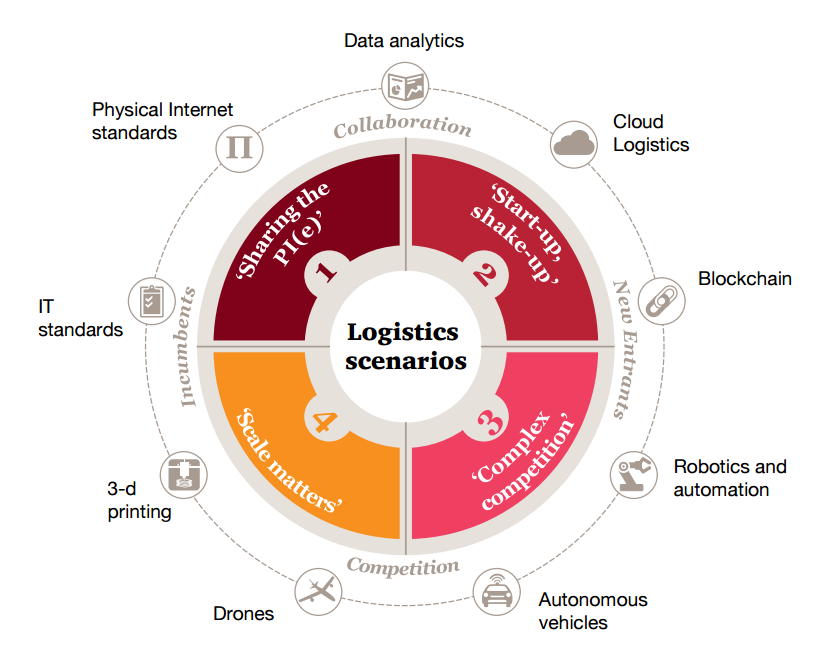
Individual and businesses expect to get goods faster, and more flexibly and at low or no cost delivery. Manufacturing is becoming more and more customized, which is good for customers but hard work for the logistics industry.  It can only hope to do this by making maximum and intelligent use of technology, from data analytics to automation to the 'Physical Internet. This promises lower costs, improved efficiency and the opportunity to make genuine breakthroughs in the way the industry works. But 'digital fitness" is a challenge for the sector, which is currently lagging many of its customers in this respect.

The report offers predictions as to what the logistics marketplace will look like in 5 to 10 years.  Here are some trends:

 -- Sharing the PI(e) -- The dominant theme in this scenario is the growth of collaborative working, which allows the current market leaders to retain their dominance. This could for example see a great use of the Physical Internet (PI) solutions, based on a move towards more standardized shipment size, labeling and systems.

--Start-up, shake up: In this scenario new entrants in the form of start-ups make a bigger impact. The most challenging and costly last mile of delivery will become more fragmented, exploiting new technologies like platform and crowd-sharing solutions. Theses start-ups collaborate with incumbents and complement their service offers.

--Complex competition: Here the competitive set evolves in a different direction, as large industrial or retail customers and suppliers become players in the logistics market themselves, not just managing their own logistics but turning that expertise into a profitable business model.

--Scale matters: The current market leaders compete for a dominant market position by acquiring smaller players, achieving scale through consolidation and innovation through the acquisition of smaller entrepreneurial start-ups.

Source: PWC

Tuesday, 25 October 2016

UBER DOES IT - Uber Self-Driving Truck Packed With Budweiser Makes First Delivery in Colorado


A tractor trailer full of beer drove itself down Colorado's I-25 last week with nobody behind the wheel. Uber Technologies Inc. and Anheuser-Busch InBev NV teamed up on the delivery, which they said is the first time a self-driving truck had been used to make a commercial shipment.
With a police cruiser in tow, the 18-wheeler cruised more than 120 miles while a truck driver hung out back in the sleeper cab, the companies said. The delivery appears to be mostly a stunt—proof that Otto, the self-driving vehicle group that Uber acquired in July, could successfully put an autonomous truck into the wild.

"We wanted to show that the basic building blocks of the technology are here; we have the capability of doing that on a highway," said Lior Ron, the president and co-founder of Uber's Otto unit. "We are still in the development stages, iterating on the hardware and software."

AB InBev said it could save $50 million a year in the U.S. if the beverage giant could deploy autonomous trucks across its distribution network, even if drivers continued to ride along and supplement the technology. Those savings would come from reduced fuel costs and a more frequent delivery schedule.

Otto spent two weeks carefully mapping the road to make sure the technology could handle it. Proving the viability of autonomous trucking has become more important amid mounting regulatory and public scrutiny. Surveys show most Americans aren't sold on the technology. The U.S. trucking industry is particularly sensitive to it. While fatalities in the industry far exceed those of other businesses and could therefore benefit from improved safety, it employed 1.5 million people in September, jobs that may be threatened by autonomous vehicles.

The death of a driver using Tesla Motors Inc.'s autopilot system in May has focused political attention on self-driving vehicles and hastened calls for regulations to keep pace with the technological advances. The U.S. Transportation Department released policy guidelines for autonomous driving, which acknowledged the technology's life-saving potential while warning of a world of "human guinea pigs."


Uber's Otto team worked with Colorado regulators to get permission for the delivery and to arrange for police supervision of the shipment, said Ron. Otto spent two weeks scoping out the driving route from Fort Collins to Colorado Springs, carefully mapping the road to make sure the technology could handle it. The team wanted the trip to take place in the early morning when traffic would be relatively light and on a day when the weather was clear. Those conditions were met last Thursday, when the delivery took place.Ron said Uber does not plan to build its own trucks and instead wants to partner with automakers, as it's doing with Volvo on self-driving cars. He said the company's discussions with truck manufacturers are in early phases.

The software still has a long way to go, too. The autonomous drive in Colorado was limited to the highway, meaning truck drivers shouldn't have to worry about finding a new profession anytime soon. "The focus has really been and will be for the future on the highway. Over 95 percent of the hours driven are on the highway," Ron said. "Even in the future as we start doing more, we still think a driver is needed in terms of supervising the vehicle."

Source Bloomberg Technology

India's Coastal Shipping initiative - Sagarmala to save up to Rs 40000 crore per year in logistics by 2025

Coal can be moved through coastal ships thereby decongesting rail networks 
Government of India's ambitious push to port-led development under the Sagarmala project will help in saving as much as Rs 40,000 crore annually in logistic costs by 2025, a report said today. 
"According to a study conducted under the Sagarmala programme, there lies a significant potential for moving raw materials and finished products using coastal shipping and inland waterways which is 60-80 per cent cheaper than road or rail transport," the Shipping Ministry said. 
Although share of coastal shipping and inland waterways in the country's modal mix remains low, an emphasis on coastal shipping to complement road and rail transport can lead to overall logistic cost savings, it added. 
"The flagship programme by the Shipping Ministry will help in reducing the logistics cost for both domestic and EXIM cargo with optimised infrastructure investment. An overall cost savings of Rs 35,000-40,000 crore per annum by 2025 is estimated from the same," the Ministry said. 
India, where the logistics cost (19 per cent of GDP) is amongst the highest in the world will undergo complete transformation under the Sagarmala Programme, by unlocking the full potential of the country's coastline and waterways. 
The programme aims to increase movement of coal through coastal route from 27 million tonnes per annum (MTPA) in 2015-16 to 129 MTPA by 2025 and increase the share of inland waterways and coastal shipping in modal mix to increase from 6 to 12 per cent, it added. 
The programme envisions reduction in the cost of power generation by Rs 0.50 per unit of power, it said. 
"It is estimated that for power plants located 800 to 1,000 km away from coal mines, the cost of coal logistics can contribute up to 35 per cent of the cost of power production," it said. 
Particularly in the case of the coastal power plants in Andhra Pradesh and Karnataka, that currently receive coal from Mahanadi Coalfields by Railways, significant savings can be achieved by taking coal through the rail-sea-rail (RSR) route. 
There are significant cost savings if Coastal shipping is used to transport Coal instead of Rail
"It is estimated that coastal movement of coal to these plants can result in annual savings of over Rs 10,000 Crore to the power sector," the Ministry noted. 
In addition, up to 50 MT of coal can be moved via coastal shipping for non-power thermal coal users (for example steel plants). Other commodities like cement and fertilisers, and food grains could also be moved through coastal shipping to the extent of about 80-85 MT by 2025. 
Additionally, an estimated 60-70 MT of cargo can also be moved over inland waterways by 2025. 
Port-led development focuses on logistics intensive industries. 
The synergistic and coordinated development of four components -- logistics intensive industries, efficient ports, seamless connectivity and requisite skill-base -- will lead to unlocking of economic value, it added. 
Source: PTI | Updated: Oct 24, 2016, 08.56 PM IST 

Friday, 21 October 2016

MRV (Monitoring, Reporting and Verification) regulation

Statutory: The MRV (Monitoring, Reporting and Verification) regulation aims to quantify and reduce CO2 emissions from shipping and will create a new kind of benchmarking system in Europe. DNV GL has prepared an overview of how MRV will affect the maritime industry and what shipping companies need to do to achieve compliance.
The regulation in a nutshell
The European Commission (EC) is bringing emissions from shipping into its 2009 climate and energy package. MRV is designed to progressively integrate maritime emissions into the EU’s policy for reducing domestic greenhouse gas emissions (EU regulation 2015/757). MRV requires ship owners and operators to annually monitor, report and verify CO2 emissions for vessels equal to or larger than 5,000 GT and which call at any EU port. The results will be published on a regular basis. Entered into force on 1 July 2015, the regulation will become fully effective on 1 January 2018. 
Shipping companies will need to prepare a monitoring plan by 31 August 2017 at the latest for each of their ships that falls under the jurisdiction of the regulation. They will have to monitor and report the verified amount of CO2 emitted by their vessels on voyages to, from and between EU ports and will also be required to provide information on energy efficiency parameters (see below). Data collection will start on a per-voyage basis from 1 January 2018. Once the data is verified by a third-party organization and sent to a central database, presumably managed by the European Maritime Safety Agency (EMSA), the aggregated ship emission and efficiency data will be published by the European Commission by 30 June 2019 and then every consecutive year. 

Monitoring and reporting

Ship owners will have to monitor the following parameters on a per-voyage basis:
  • Port of departure and port of arrival, including the date and hour of departure and arrival
  • Amount and emission factor for each type of fuel consumed in total
  • CO2 emitted
  • Distance travelled
  • Time spent at sea
  • Cargo carried
  • Transport work
In addition to the companies reporting annually aggregated figures for the parameters, the data is to be used to calculate and report average energy efficiency.
The basis for the calculation of CO2 emissions will be the fuel consumption for voyages starting or terminating at any EU port. Fuel consumption shall be determined and calculated using one of the following methods:
  • Bunker Fuel Delivery Note (BDN) and periodic stock takes of fuel tanks
  • Bunker fuel tank monitoring on board
  • Flow meters for applicable combustion processes
  • Direct CO2 emissions measurements
  • EU MRV regulations will have a significant impact
  • Verification
Accredited verifiers will have three key tasks: 1. to verify ship-specific monitoring plans, 2. to verify that the annual ship-specific emissions reports comply with the monitoring plans and 3. to verify that the figures contained in the annual ship-specific emissions reports are accurate. Presently, no companies have been granted accreditation, as criteria remain under development by the EC. It is clear that the EC will not only consider class societies as potential verifiers, but will also add other organizations to the list.

Timeline

  • 31 August 2017 – Companies are to submit ship-specific monitoring plans to verifiers for approval
  • 1 January 2018 – Per-voyage monitoring to start
  • 30 April 2019 – Verified annual emission reports submitted to the EC
  • 30 June 2019 – Emission data made publicly available by the EC
This cycle will then repeat for subsequent years. 

Outstanding issues

A number of issues governing the implementation of the regulation remain to be settled. These include details of cargo monitoring and efficiency calculation, the inclusion of AIS-based verification, criteria for accreditation of verifiers, and the development of monitoring plans and reporting templates. Industry stakeholders, including DNV GL, are providing input to the EC through the European Sustainable Shipping Forum (ESSF). The EC plans to publish documentation for the outstanding issues towards the end of 2016.

Recommended actions 

The practical impact of the MRV regulation on owners and operators is not yet fully clear. There will be a need to monitor and report data, but the exact formats and templates for doing so are not yet available. Nevertheless, it would be advisable for ship owners and operators to prepare for MRV ahead of time and start considering how to best fulfil the forthcoming monitoring and reporting obligations for their own ship as well as their shore systems and routines ahead of time. Steps such as developing the mandated monitoring plan as well as examining how to best collect, aggregate and report fuel consumption and transport work data for their ships are particularly important.