Tuesday, 8 August 2023

Indian Coir products exports at an all time high


India is the largest coir producer in the world accounting for more than 80 per cent of the total world production.

Coir products are now being exported to 110 countries of the world. 

With the participation of 80 per cent of women workers, the rural economy is getting strengthened. Coir products are eco-friendly, along with the Prime Minister’s vision #localforglobal.

Coir is a natural fibre extracted from the husk of the coconut shell and is used to make a variety of products such as yarns, piths, ropes, mats, mattresses, baskets, brushes, brooms, coir logs etc. 

India is the largest coir producer in the world accounting for more than 80 per cent of the total world production. The coir industry primarily comprises small-scale and cottage industries in the coastal regions of India. States such as Kerala, Tamil Nadu, Andhra Pradesh and Karnataka are the leading producers of coconuts, contributing to 90 per cent of the total production. 

Coir exports have been increasing year on year, from Rs 2,532 crore in 2017-18 to Rs 4,340 crore in 2021-22, as per the annual report published by the Coir Board. 

In the financial year 2021-22, India reported a record export of coir and coir products amounting to 12,34,855 MT valued at Rs 4340.05 crores. According to the Coir Board, the export registered a growth rate of 6.2 per cent in quantity and 14.8 per cent in value.

Amongst the products, coir pith was the most exported commodity with 3.99 lakh MT worth Rs 2,259.17 crores followed by coir fibre and tufted mats in terms of value.

The United States of America was the leading export destination, valued at Rs 1,293 lakh crore, followed by China with a value of Rs 8,602.5 crore. 

The Coir Board of India is a statutory body established under the Coir Industries Act, of 1953,  by the government of India. Its primary mandate is the development and promotion of the coir (coconut fibre) industry in India 

Wednesday, 14 June 2023

India's seafood exports hit all-time high in FY 2022-23, grow 26.73% in quantity & 4.31% in value

India's seafood exports hit all-time high in FY 2022-23, grow 26.73% in quantity & 4.31% in value 

India FY23 seafood exports at record $8.09 bn 

Frozen shrimp remains major export item in terms of quantity and value; U.S., China turn major importers of India’s seafood


India exported 17,35,286 tonnes of seafood worth ₹63,969.14 crore ($8.09 billion) during 2022-23, with frozen shrimp remaining the major export item in terms of quantity and value, while the United States and China turned out to be the major importers of India’s seafood, said a release from the Marine Products Export Development Authority (MPEDA) here on 14-06-2023.

During financial year 2022-23, export improved in quantity terms by 26.73%, in rupee terms by 11.08%, and in dollar terms by 4.31%. In 2021-22, India exported 13,69,264 tonnes of seafood worth ₹57,586.48 crore ($7,759.58 million), said MPEDA chairman D.V. Swamy.

India did well to achieve all-time high exports worth $8.09 billion with a volume of 17,35,286 tonnes despite several challenges in its major export markets like the US.

Frozen shrimp, which earned ₹43,135.58 crore ($5481.63 million), retained its position as the most significant item in the basket of seafood exports, accounting for a share of 40.98% in quantity and 67.72% of the total dollar earnings.

The overall export of frozen shrimp during 2022-23 was pegged at 7,11,099 tonnes. The US, the largest market, imported 2,75,662 tonnes of frozen shrimp, followed by China (1,45,743 tonnes) European Union (95,377 tonnes), South East Asia (65,466 tonnes), Japan (40,975 tonnes), and West Asia (31,647 tonnes).

The export of black tiger shrimp went up by 74.06%, 68.64%, and 55.41% in quantity, rupee value and dollar terms respectively in 2022-23.

Vannamei shrimp exports declined in 2022-23 compared to 2021-22 by 8.11% from $5234.36 million to $4809.99 million.

Frozen fish, the second largest export item, fetched ₹5,503.18 crore ($687.05 million) accounting for 21.24% in quantity and 8.49% in dollar earnings. The export of frozen fish increased by 62.65%, 58.51%, and 45.73% in quantity, rupee and dollar value terms respectively.

Tuesday, 30 May 2023

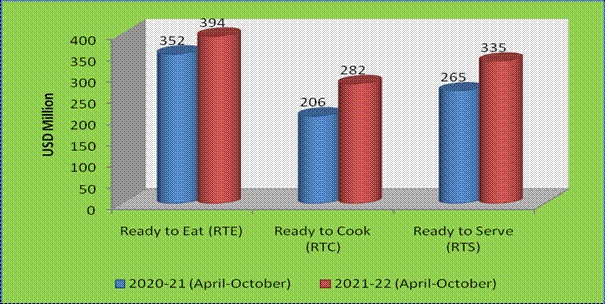
India’s Exports of Ready To Eat products rises by 24% to $ 394 million in 2021-22 (April-October) compared to 2020-21 (April-October)

India’s Exports of Ready To Eat products rises by 24% to $ 394 million in 2021-22 (April-October) compared to 2020-21 (April-October)

India’s export of final consumer food products such as Ready to Eat (RTE), Ready to Cook (RTC) and Ready to Serve (RTS) under the APEDA basket has registered a significant growth in the last one decade.

With the Ministry of Commerce & Industry laying thrust on Value Addition of products for exports, the food products under the RTE category have registered an Compound Annual Growth Rate (CAGR) of 12 per cent in the last one decade and the share of RTE in APEDA export has increased from 2.1 per cent to 5 per cent during the same period.

The export of products under Ready to Eat (RTE), Ready to Cook (RTC) and Ready to Serve (RTS) segment have registered an CAGR of 10.4 per cent from 2011-12 to 2020-21. India exported more than $ 2.14 billion worth of final food products in 2020-21. Since final food products are time saving and readily available, the demand for food items under the categories of RTE, RTC and RTS has increased manifold in recent years.

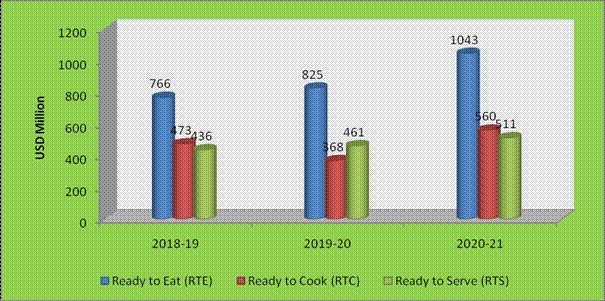
The export of products under RTE, RTC and RTS categories rose by more than 23% to $ 1011 million in April – October (2021-22) compared to $ 823 million reported in April – October (2020-21). In view of this, export of RTE/RTC and RTS for last three years is placed in below graph.  
Source: DGCIS


According to the latest Directorate General of Commercial Intelligence and Statistics data, India exported final food products which includes RTE, RTC and RTS, worth USD 5,438 million in the last three financial three years (2018-19 and 2020-2021).

In 2018-2019, India recorded RTE exports of USD 766 million, which rose to USD 825 million in 2019-20 and USD 1043 million in 2020-21. Meanwhile, the RTC food products recorded an export of USD 473 million in 2018-19, USD 368 million in 2019-20 and USD 560 million in 2020-21. A comparative analysis of RTE/RTC and RTS for the current year, April--October (2021-22) against previous years for the same periods is placed in below graph. Export value of RTE/RTC and RTS has increased in 2021-22 against previous year.  
Source: DGCIS


The RTS food category registered an export of USD 436 million in 2018-19, USD 461 million in 2019-20 and USD 511 million in 2020-21.

The products covered under RTE category, includes Biscuits & Confectionery, Jaggery, Breakfast Cereals, Wafers, Indian Sweets and Snacks, Pan Masala & Betal Nuts etc. The Biscuits and Confectionery and Indian Sweets and Snacks constitute a major share of 89% in the RTE export in 2020-21.

The share of each category in RTE export are 52.32% (Biscuits & Confectionery), 1.52% (Jaggery), 4.11% (breakfast cereals), 1.73% (wafers), 37.04% (Indian sweets and snacks), and 3.28% (Pan Masala and Betal nuts).

The growth rate of RTE in 2020-21 against previous year was 26% while growth in Biscuits & Confectionery category recorded at 28.87%, Jaggery at 48.18%, Breakfast Cereals at 4.24%, Indian sweets and snacks at 29.75%, Pan Masala and B’nuts at 4.2% for the same period.

Notably more than 56% of RTE food products were exported to top 10 countries in 2020-21. USA is the top importing country in four categories of RTE products such as Biscuits & Confectionery (USD 79.54 million), Breakfast cereals (USD 5.33 million), Indian sweets and snacks (USD 99.7 million), Pan Masala & Betal Nuts (USD 5.95 million) while the remaining two products under RTE are significantly imported by Malaysia and Nepal. Malaysia imported Jaggery worth of USD 5.09 million and Nepal imported Wafers worth of USD 3.5 million in 2020-21.

The major destination of RTE export as per 2020-21 data are U.S.A (18.73%), U.A.E (8.64%), Nepal (5%), Canada (4.77%), Sri Lanka (4.47%), Australia (4.2%), Sudan (2.95%), U.K (2.88%), Nigeria (2.38%), Singapore (2.01%).

The RTC food products have been growing at CAGR of 7 per cent in the last one decade and the share of RTC in APEDA export has increased from 1.8 per cent to 2.7 per cent in the same periods. The major categories of food products covered under RTC are ready to cook, papad, flours and milled products and powder and starch. The category-wise share in RTC export is ready to cook (31.69%), papad (9.68%), flours and milled products (34.34%) and powder & starch (24.28%).

The growth rate of RTC in 2020-21 against previous year is 52 per cent while category wise growth rate of RTC is highest for powder and starch (174%) followed by Flours and Milled Products (36%), Ready to Cook (35%) and Papad (19%) in 2020-21 against previous year.

Above 74% of RTC food products were exported to top 10 countries in 2020-21 and USA is the top importing country of Flours and Milled Products and Ready to Cook from India in 2020-21 while two countries namely UK and Indonesia are at the top in importing of Papad and Powder & Starch during 2020-21.

The major exporting destination for RTC export in 2020-21 are U.S.A (USD 18.62 million), Malaysia (USD 11.52 million), U.A.E (USD 8.75 million), Indonesia (USD 7.52 million), UK (USD 7.33 million), Nepal (USD 5.89 million), Canada (USD 4.31 million), Australia (USD 4.2 million), Bangladesh (USD 3.43 million) and Qatar (USD 2.76 million).

In the category of RTS, the export has been growing at an CAGR of 11 per cent in the last one decade. The major final food products under the RTS category include jellies, squash & juices, other beverages, energy products/drinks and ice cream, soups, sauces, pasta and seasoning. The share of RTS has increased from 1.1 per cent to 2.5 per cent in last one decade.


The growth rate of RTS in 2020-21 against previous year (2019-20) is 11 per cent while category-wise growth rate of RTS is highest for Energy Products/Drinks (31.10%) followed by Ice Cream, Soups, Sauces, Pasta and Seasoning (19.34%), other beverages (14.12%).

The rise in export of agricultural and processed food products has been largely due to the various initiatives taken by APEDA such as organizing B2B exhibitions in different countries, exploring new potential markets through product specific and general marketing campaigns by active involvement of Indian Embassies.

APEDA has also taken several initiatives to promote geographical indications (GI) registered agricultural and processed food products in India by organizing virtual Buyer Seller Meets on agricultural and food products with the major importing countries across the world.

In order to ensure seamless quality certification of products to be exported, APEDA has recognized 220 labs across India to provide services of testing to a wide range of products and exporters.

APEDA also assists in upgradation and strengthening of recognized laboratories for export testing and residue monitoring plans. APEDA also provides assistance under the financial assistance schemes of infrastructure development, quality improvement and market development for boosting export of agricultural products.

India’s exports of RTE, RTC & RTS (USD million)


2018-19

2019-20

2020-21

2020-21

(April-October)

2021-22 (April-October)

Ready to Eat (RTE)

766

825

1043

352

394

Ready to Cook (RTC)

473

368

560

206

282

Ready to Serve (RTS)

436

461

511

265

335

Source: DGCIS\

Monday, 29 May 2023

Rubber industry looks to double exports by 2025


The $2-billion non-tyre rubber sector is aiming to double its exports by 2025, according to the All India Rubber Industries Association (AIRIA).

AIRIA president Sawar Dhanania said the global market for rubber products which is estimated at around $212 billion today is also expected to grow by 2025. “Because MSMEs are so important to India’s economy and commerce, we believe that India’s free trade agreements (FTAs) should include provisions to address the special concerns, demands and barriers that MSMEs may face while doing business in foreign markets,” Dhanania said at a meeting of the association in Mumbai.

He said the government should take steps to ensure that the terms of the FTAs benefit the MSMEs for internalisation, with trade facilitation mainstreamed in MSME development goals. “MSMEs can work world-wide by creating a level playing export infrastructure, improving their financing conditions, educating them about suitable marketing channels and facilitating their working with trading companies,” he said.

Shashi Singh, senior vice president of AIRIA, said, “Indian Institute of Foreign Trade (IIFT) and the export promotion councils should educate MSMEs on export procedures, documentation requirements, and the finer points of export.” “We expect IIFT and the EPCs should share export market intelligence and arrange specialist meets. It will be beneficial to individuals who are new to exports and wish to understand how to become export-ready,” Singh said.

“In the last 1-1.5 years, the government released Rs 55,000 crore under MEIS incentives as a reward. There are 13 trade agreements under which 12 are already implemented. Under India and the UAE agreement, 97% of Indian products exported get the direct benefit,” said Ramesh Holiachi, Joint Director General of Foreign Trade.

“The India and Australia agreement is yet to be notified by the Indian government. The Australian government has provided geo-duty concessions to India…. 91-97% of Indian products will get duty concession in the Australian market. Footwear, pharmaceuticals and textile industry in India will benefit from this agreement,” said Holiachi.   

Sunday, 21 May 2023

South Korea expands container shipping links to Russia


South Korea has expanded its container shipping links with Russia, the port of Donghae starting a container liner service linking it with far-eastern ports.

Feeder operator Dong Young Shipping will extend its shuttle service between Busan and Vladivostok to include a call at Donghae, on the eastern part of the Korean peninsula.

The revamped  service will start at the end of June, and officials at Donghae say they hope it will revitalise the port and regional development through the growing trade in the northern economic bloc.

South Korea’s primary exports to Russia are used cars, automobile parts, electronics and cosmetics, while coming from Russia are wood pellets, roughage and marine products.

A subsidiary of long-established feeder operator Namsung Shipping, Dong Young launched its Busan-Vladivostok service in June 2021. Currently, it is served by the chartered 650 teu Xiang Ren, but more vessels could be added if response to the extended loop is good.

Meanwhile, Sinotrans Container Lines, part of China’s state-owned China Merchants group, is to launch a container service, the RS1, on 23 May, calling at Shanghai, Busan and Vladivostok with two 700 teu ships, SCO Shanghai and SCO Qingdao.

Tempted by healthy trade between Asia, India and Russia, and unfazed by sanctions, several intra-Asia carriers and start-ups have launched services connecting these regions.

Sanctions against Russia are almost exclusively western and most of Asia has benefited from this by increasing trade with Russia. 

Linerlytica’s latest report says that, as of 15 May, 102 ships, for 107,583 teu, are active in the Russia Far East trade, up from 98 a month ago.


South Korean regional carrier Sinokor Merchant Marine has also maintained its Busan-Vladivostok liner service, Cargoes carried by Sinokor to Vladivostok are then received by Russia’s FESCO and Sakhalin Shipping Company. It has been surmised that if there are no longer ocean freight services between South Korea and Russia, many small and mid-sized South Korean exporters will lose an outlet for their goods.

Tuesday, 25 April 2023

EU, US buy Clean Green Ships Made In India

EU, US buy Clean Green Ships Made In India


India has started supplying ‘green ships’ to traditional shipbuilding nations Norway, Germany and the US, boosting its ambition to become a global shipping hub.

The move comes amid an international environmental focus on the shipping industry. While ships are responsible for ferrying the overwhelming majority of goods around the world, they are also responsible for emitting substantial amounts of greenhouse gases.

The issue has become critical since the global energy crisis caused by the Russia-Ukraine war, which has sparked renewed interest in making ’green ships’—vessels that typically run on less polluting fuels such as methanol, electricity, green hydrogen and hybrid batteries.

Recently, state-run Cochin Shipyards Ltd (CSL) delivered two fully electric cargo ferries to Norway. And many more orders are in the pipeline. The development marks a surprise reversal of India’s earlier strategy of looking at sourcing green vessels from Europe and the US. CSL has also bagged contracts for building two vessels from European clients that will be fuelled by methanol.

In addition, the shipyard has signed contracts with Norwegian clients for building two container vessels to be fuelled by green hydrogen. Another contract for supplying eight ‘eco-freighters’ to HS Schiffahrts Group, Germany. marks CSL’s entry into the so-called short-sea shipping market, which consists of ports located in Europe.The private sector too is helping strengthen domestic maritime manufacturing. Goa-based Chowgule and Co has bagged contracts for building eight electric hybrid cargo vessels from European clients.

Shipping minister Sarbananda Sonowal said that more such orders are expected to be placed by European clients with Indian shipyards.

“Most advanced countries are placing orders vessels with Indian companies. This is a clear indication that ‘make in India’ is becoming successful and Atmanirbhar Bharat initiative is getting strengthened," Sonowal said.

Apart from Norway and Germany, Indian shipbuilders are close to striking deals with companies in the US, Netherlands, Denmark and West Asia. Closer to home, contracts are also being looked at from Bangladesh, Sri Lanka and Myanmar. The minister said that Norway and India would cooperate on developing infrastructure for manufacture of green passenger and cargo vessels which would be used for both the domestic and global markets. “Apart from CSL, several Indian ship design and technology firms are also actively working towards delivering green ship solutions. With new initiatives Indian ports will have a globally visible green profile and our shipyards can aspire to be a green tug building hub for the world. With the National Centre of Excellence in Green Ports and Shipping acting as a nodal entity for the industry all such efforts will gain momentum and India can position as a ‘Global hub for building ‘Green Ships’," the minister said.

On its part, the centre is providing funds through the Shipbuilding Financial Assistance Policy (SBFA) to Indian shipyards in order to make India a sought-after destination for technologically advanced green ships.

As per Maritime India Vision – 2030, a clear roadmap has been provided for bringing an all-round improvement, be it in the area of Port modernization and Automation, Coastal Shipping, Shipbuilding, Ship Repair, Transition to Renewable Energy, increasing share of Indian Seafarers across the globe, improving Vessel Turnaround Time, developing Transhipment hubs, Cruise shipping and augmenting capacities at the Major Ports. Focus is also on developing and operationalizing Inland Waterways for improved connectivity and creating an environment for positive modal shift from road and rail to waterways.

Tuesday, 18 April 2023

Direct main-line container service from Mangalore Port to boost connectivity and exports

Direct main-line container service from Mangalore Port to boost connectivity & exports


A.V. Ramana, chairman, NMPA, inaugurating the first direct mainline service from New Mangalore Port by flagging off the container discharging from the vessel on 13th April 2023.

New Mangalore Port (NMP) has recently commenced its dedicated container terminal, and it has already received its first direct main-line vessel, the MV HONG AN. 

The regular service vessel will operate between the westbound rotation of Chittagong - Colombo - Mangalore - Nhava Sheva - Mundra; and the eastbound leg to Jebel Ali-Khalifa Port. This will be a direct liner service for Indian exporters to Jebel Ali and Abu Dhabi with seamless connections to the USA, Europe, South East Asia, and Africa.

The mainline service got introduced primarily as a result of the use of various productivity measures to free up berth time for new services through the establishment of a fixed window berthing policy and the extension of additional inducements in the form of commercial rebates on vessel-related costs.

The mainline service will be a game changer in how shippers ( from Mangalore, Udupi and hinterland) take their exports to the global markets in the fastest and most efficient ways. It will not only lead to more sea route options, but it can also seamlessly connect cargoes for air transfers from Dubai to destinations in Europe and USA.


The advantages include the transit time which will get reduced to half. The transit time to Jebel Ali earlier was 13-15 days. With direct service, it will get reduced by seven days.


The mainline service will avoid transshipment, which will result in better ocean freight cost for shipments. The new service will also give a major boost to export from Karnataka, particularly agricultural products, the release added.