Thursday, 28 April 2022

How To Use Digital Marketing in Logistics


The internet is burgeoning with information on the power of B2B digital marketing, but most logistics companies are neglecting to invest in their digital presence. The irony is that logistics is the perfect industry in which digital marketing (done right) can grow your business, for 2 reasons:

1. Customer relationships rely heavily on trust. Digital marketing helps build trust!

2. Digital marketing gives you an opportunity to set yourself above the competition by establishing your expertise.


A recent analysis of the websites of 20 randomly selected logistics firms revealed:

Only 35% had mobile optimized websites, and less than half even had basic web analytics installed on their site. In addition, our research indicates fewer than 5% of Florida logistics companies are using marketing automation or retargeting advertisements.


Digital Marketing Strategies Used by Logistics Companies

Logistics, supply chain, and transportation industries have historically relied on relationship-based selling to grow their business. But when you don’t have established relationships, how do you grow your business?

This is where logistics marketing strategies come in. Utilizing software such as CRMs, Marketing Automation, or Audience Targeting to build and grow relationships with potential (and current) customers can help grow your business more sustainably than current practices.

The lag in investment in online marketing by logistics businesses creates an opportunity for your organization to use these tactics to get ahead of the competition.

We will go through 3 types of software you can implement to get your brand in front of the right audience before they make a decision as well as how they can be used to align marketing with sales.


CRM Software

Customer Relationship Management (CRM) software helps businesses manage future and current customer data and interactions. In other words, it helps you understand who your customers are and how they interact with your organization.

For a potential customer to choose you to carry their cargo, they need to know they can trust you. This means your team is going to need to build a relationship with that prospect.

Members of your sales team can use information in a CRM to have personalized conversations with contacts based on their previous interactions with the company, increasing the likelihood of closing deals with prospects in the future.

CRM software also supports company growth by automating manual data entry and outlining clear processes for following up with contacts.

Some warehouse management systems (WMS) include a basic CRM. This can be a viable solution. Its recommended that you check if the provided CRM software automates your processes, connects to your marketing activities and, ideally, is cloud-based.


Marketing Automation Software

The Survey of 20 randomly selected logistics firms indicate fewer than 5% use marketing automation software.

Marketing automation can automate repetitive marketing activities such as email, social media, and website activities. If used correctly, it can help build and reinforce relationships with leads and customers.

In a study, 84% of respondents cited increased lead generation as a key benefit of marketing automation, while 73% cited better prospect and lead insight, as well as increased efficiency.

Marketing Automation and CRM are sometimes conflated as the same thing because most marketing automation software includes a CRM component.

While its recommended integrating your marketing automation and CRM software, they are two completely separate entities. But, it is important to keep data in sync so marketing and sales teams are on the same page in regard to a prospect’s activities.

By integrating marketing automation and CRM, you’re a creating a single, unified funnel for interactions with prospects. Here is an example from HubSpot, a leader in the digital marketing industry:


Marketing & Sales Funnel


Source: HubSpot

Marketing automation is at the top of the funnel, bringing in new leads while simultaneously working with sales to qualify and nurture those relationships into customers.


Online Ad & Audience Targeting Software

The final piece to the puzzle is online audience targeting and advertising software known as programmatic advertising. While CRM and marketing automation nurture contacts and prospects, programmatic advertising uses software to promote your brand and obtain those prospects.

Programmatic ad buying opens the doors for logistics organizations to target their audience online. One way to ensure your ads are reaching your target audience is through behavioral targeting.

Behavioral targeting allows you to show your ads to people online based on their job title, industry, purchasing behavior, geographic location, age range, etc. Instead of buying advertising on one website at a time, behavioral targeting lets you buy advertising on thousands of websites but only show that advertising to individuals who match your target audience.

Another method of programmatic ad buying is retargeting. Retargeting allows you to put your online advertising in front of only the people who have already visited your website but did not inquire on your services.

A recent article in Entrepreneur titled “The Web’s Most Effective Ads” describes retargeting as technologies “online entrepreneurs cannot afford to overlook.” And according to our research, fewer than 5% of logistics companies are using them.


To Sum it up

One fact is abundantly clear: logistics businesses obtain (and retain) customers through relationships built on trust. If they can’t trust you, they won’t use you. And while these 3 tactics may only comprise a small portion of the ways digital marketing can help you build that trust, they are invaluable first steps in logistics marketing. With the right synchronized technology, your integrated sales and marketing efforts will be prepared to scale as your logistics company grows from your marketing efforts.

Friday, 8 April 2022

All About the Indispensable PALLET


The foundation of bulk global shipping is quite simple — it’s all about the pallet. This stable, flat transport structure is topped with packaged goods that are secured by shrink wrap or straps. Pallets are lifted by forklift, front loader or crane, stacked neatly and then loaded onto trucks, trains, cargo ships, or airplanes for their global journey to market.

In fact, nearly two billion pallets are used every year in the U.S. to efficiently transport goods. Certainly, they facilitate the ease of transport — getting goods from Point A to Point B on schedule. But they also help preserve the integrity and high quality of goods being shipped. That’s important for all goods, but most critically for pharmaceuticals, given that any missteps could jeopardize the integrity of the entire shipment.
Pallets are a booming business. EMR’s research shows that the burgeoning global pallet market was valued at $82.59 billion in 2020 and will soar to nearly $115.17 billion by 2026. The use of pallets cuts loading time, enhances safety for workers, improves transport efficiency, and protects products.
High-quality pallets are the linchpins for safely, efficiently moving everything from pharmaceuticals to fresh produce, machinery, chemicals, construction materials, and consumer goods to market.
 
2022 Pallet Challenges
That said, significant pallet challenges emerged throughout 2020 and 2021 and have carried into 2022. Most onerous? It’s the continuing shortage of pallets, which, in turn, is driving up pallet pricing. Shortages of new pallets – mostly made of wood — are attributable to everything from business labor woes and high lumber costs, to increases in new housing construction, an increase in consumer do-it-yourself projects, forest fires that cut down on logging efforts, and renewed lumber demand from overseas markets, among several other reasons.
Sometimes, big distribution centers and major retailers also get first dibs on new pallets, which can impact supply availability for other customers.  In addition, the rate of new pallet production simply isn’t keeping up with demand, and at the same time, fewer pallet “cores” or used pallets are available for sale.
Despite the litany of challenges, we remain committed to helping our clients navigate through the current minefield of pallet shortages. We know that logistics managers within our clients’ companies have enough stressors to deal with in 2022 – everything from escalating prices for materials to product scarcity, delivery delays and increased client demand.” With all that in mind, Onofre offers a few “best practices tips” as regards to the pallet world in 2022.
 
Best Business Practices
Tip 1: Logistics managers must carefully assess their pallet quantity needs and communicate about those to their pallet supplier well in advance.
“Last minute” is often no longer an option as it was several years ago. Plenty of advance notice during this era means that our customers will have the best chance of receiving the number of pallets they requested.
In addition, significant advance notice can help assure the size of pallets received remains consistent. That’s important for protecting cargo from external damage. For example, if pallets are inconsistent size-wise, the entire shipment could suffer with gradual damage along the edges and corners of the stack of boxes.

For some products, even minor damage to the overall packing material is often considered as full-fledged damage to the entire shipment, even if the material within is untouched,

Tip 2: Be aware that new technology has created some new options for pallets. While an estimated 95 percent of all pallets are wood, plastic pallets and other choices exist too. Some wooden pallets may have protruding nails that can create the potential for punctures. Clients know that some products being shipped including pharmaceuticals or chemicals have ingredients that could prove harmful if exposed to air, so consider the use of new-technology plastic pallets as a possible option, depending on your specific shipment.

Tip 3: Be loyal when it comes to your pallet supplier. Focus on fostering a long-term relationship. Remember that any supplier’s challenges are exacerbated when customers make major, last-minute changes or when a client threatens to buy from a competing supplier to save a few pennies. Those tactics often fail to achieve the desired result. Treat pallet suppliers as you’d wish to be treated. Build a superb business relationship to protect the quality of your shipping materials’ supply chain.
 
Navigating through 2022
Pallet makers continue to be plagued by a lack of materials such as the wood for planks or steel for nails, as well as lack of workers at times. That’s caused supply chain shortages resulting in pricing spikes of several hundred percent. Sometimes the pallets (much as with storage cargo containers over the past two years) are simply located in the wrong part of the world to satisfy customer demand.
Rising prices for pallets is the reality. Solutions to hold the line on price increase include buying in bulk from pallet manufacturers. But the reality is that costs are soaring. Unfortunately, demand is currently exceeding supply. That may continue for several years.

Still, the global pallet market is expected to grow at a compound annual rate of about 5.4 percent between 2022 through 2027, according to EMR research. Pricing and availability will hopefully stabilize over time. 

Once, pallets were simply a corporate after-thought. They were also plentiful in supply. Today, they are sometimes in short supply yet remain a vital resource needed for supply chain integrity. 

Since pallets ‘rule’ the bulk shipping world, working with a logistics firm such as Transmarine Group that knows how to navigate the current marketplace challenges is vital. Our goal is to get your goods into the hands of consumers in a timely manner – which we know is so important for your business. 

Wednesday, 6 April 2022

Meet The Black Swan : An advanced cargo UAV pushing the limits in Airfreight


Like black swans, the ability to fly cargo at the cost of road freight has long been considered impossible to exist. But with the unveiling of an advanced drone - The Black Swan from Dronamics pushes the limit of what’s possible in airfreight. 

Dronamics, a developer and operator of large cargo has to launched its Black Swan unmanned plane that can fly cargo at the cost of road freight.

Said a spokesperson: “Deceptively simple, the Black Swan isn’t just another UAV, it’s a whole new class of aircraft. “Able to carry up to 350 kg of cargo at a distance of up to 2,500 km at up to 80% lower cost than any aircraft in existence, the Black Swan can operate from runways as short as 400 meters, unpaved, and will enable Dronamics to serve customers in even the smallest and most remote communities, ushering in a whole new era in fast, affordable airfreight for the whole world.”

The company said that operators will no longer be forced to choose between low-cost road freight that can take days to deliver or fast air freight that is ever so expensive, adding that same day, affordable airfreight is finally here.


Svilen Rangelov, Dronamics co-founder and chief executive, said: “The unveiling of the Black Swan represents a critical milestone in the company’s mission to enable same-day shipping for everyone everywhere.

“The years of hard work are paying off and as soon as we’re done with our extensive test program and obtain certification in 2022, we are going to begin commercial operations, serving customers in Europe and beyond years ahead of everyone else.”

Konstantin Rangelov, Dronamics co-founder and CTO, said: “For more than 100 years people have designed airplanes for humans first, meaning they were never really optimized for cargo, and in fact, they’re quite inefficient.

“By being extremely focused solely on carrying cargo, we were able to develop an aircraft that is able to do the job at up to 80% lower cost than any other airplane, meaning we can bring the benefits of aviation to billions of people around the world who do not get regular air service.”

Dronamics plans to roll out a global network of droneports, allowing the Black Swan to provide the missing “middle mile” in airfreight.  Added the spokesperson: “Whether ferrying vital supplies between islands or delivering critical spare parts deep into a country, Dronamics will link towns and cities around the world with each other in a way simply never possible before.

“Able to run on 100% sustainable aviation fuel, it will do so in a more environmentally friendly manner than any previous aircraft in existence, enabling global partners like DHL and Hellmann Logistics to not only serve their customers in the fastest way possible, but also in the greenest one as well.”

Thursday, 31 March 2022

Cross Trade Shipments / Triangle Shipments Explained


What Is Cross Trade Shipping?  

If you are shipping goods to a buyer overseas, you are probably looking to reduce costs across your supply chain. There are many ways to do this, including organizing your shipment through a cross trade routing.

Below, we share relevant info on cross trade shipping. We will outline what a cross trade is, why you should use it, how to use it and what you should keep in mind when deciding to ship using cross trades.


What are cross trades?

A cross trade is a shipment organised between two countries – none of which the seller is locally based in. They’re also known as foreign-to-foreign shipments, third party shipments or – more commonly – triangle shipments.

Think about it this way: you are selling a product to someone in USA, but your product is manufactured in Thailand. A cross trade transaction involves shipping your product directly from Thailand to USA.

It’s called a ‘triangle shipment’ because there are three countries involved in the transaction – the country of origin, the destination, and your business in India.

Cross trading has become very popular as more and more Australian businesses enter into international markets.


Why would I use a cross trade?

There are many reasons businesses use cross trades – all of which can end up saving you money in the long-term. Here’s why exporters should use cross trades when selling their product overseas:

Accessing new markets – cross trades are a great way to break into a new market without having the extra expense of on-selling your product from your local country once it’s already been imported.

Lower supply chain costs – the supply chain is one area where so many costs can be streamlined. Cross trades completely remove the need to bring goods into the seller’s country, which means removing freight costs, duty costs and taxes associated with initially importing the product.

Less transit time – why export to your seller’s country if it’s halfway across the world? Cross trade shipments can reduce transit times, meaning greater cost savings for your business (imagine the time that can be saved by shipping from China to Japan, rather than from China to Australia and then on to Japan).

Efficiency in the supply chain – Cross trades bring production and stock closer to the final destination, as the whole supply chain becomes decentralised.

Using a local forwarder – Rather than trying to find someone overseas to manage a cross trade for you, you can deal with your local forwarder in your own time zone, who will manage the complexities of each country for you whilst you keep one local contact.


How do you organize a cross trade?

Organizing a cross-trade is easy if you just follow these simple steps.

Contact us with details of your goods, the manufacturer and the buyer. Also let us know the size of your consignment and if you’d prefer to ship your goods by sea or air.

We will then give you a quote of how much this is going to cost you. If you’re happy with the quote, you’re good to go.

We will then liaise with all overseas agents and make all the bookings to co-ordinate your shipment. All documents will be centralised through us.

Note that the commercial sell rate of your products will be the commercial invoice used on entry to the destination country (not your manufacturer’s invoice).

Also, the Bill of Lading will specify the client in Australia as shipper (a switch bill of lading will used to replace this information from the original bill of lading). For a brief discussion on the types of bill of ladings available, see our blog on the topic.


What should you be aware of when organizing cross trade shipping?

To ensure your shipment goes smoothly, there are a couple of things you should keep in mind:.

Make sure you tell your forwarder if you want your shipping to be neutral. This means we will withhold all the details of your manufacturer from your buyer (thereby stopping your buyer from contacting the manufacturer directly to purchase the product).

Consider an adequate marine insurance policy. You don’t want to sell your product, only to discover that something on the ship has gone wrong (loss or damage) and you have no insurance to cover it!

Ensure you use the right incoterms to suit your shipment (Incoterms are the international commercial terms that allocate risk between a buyer and seller in an international shipment).

Understand the benefits of any applicable free trade agreements. If there’s an agreement between the country of origin and the destination country, use it to your advantage!

Remember there will be three freight forwarding parties involved all co-ordinated through your one contact (namely, us).


Using an expert freight forwarder to manage your cross trade

International shipping can be a bit of a minefield. Cross trades, in particular, can be complex. Your forwarder will be able to identify rules between the different countries and how they affect your cargo. You can contact us for cross trade shipping, giving you complete peace of mind!

Wednesday, 23 March 2022

Major Logistics Trends Shaping Logistics Management in 2022

Major Logistics Trends Shaping Logistics Management in 2022


The unwritten rule across any industry (& also logistics industry) is that disruptive forces are constantly at play, reshaping the way organizations think about technology, conduct business, and look to the future. 
From new technologies to explore and take advantage of, to shifting regulations that require new strategies and tactics to ensure compliance, logistics companies must stay plugged into new and emerging trends to stay at the bleeding edge and remain competitive.

Companies that succeed are the ones who embrace a combination of the latest trends and utilize them in a way that capitalizes on traditional and established technologies.


Let us analyze the trends shaping logistics management: 

1. RFID

For over a decade, Radio-frequency Identity (RFID) chips have promised to provide real-time tracking information. However, while many OFD (out-for-delivery) companies have invested a lot of money in RFID, they have yet to see a real ROI from the technology.

So why is that? Simply having RFID chips doesn’t mean you have better access to the data, because you need computers near the data to collect it and share it.

Companies also need file-based integration technology that is able to connect devices and edge computing systems back to the core enterprise systems to transfer reporting documents and where the data can be stored and analyzed for insight and business decision making.

Further, the logistics companies that do utilize RFID technology to a value-producing extent are the ones that are able to blend traditional line-of-sight technology such as barcode labels with RFID. Barcode labels are well-established and relatively low cost. The underlying systems and business processes are well-understood and common.

By comparison, RFID implementation can be a high-cost addition to the logistics supply chain. Some estimate a 10X cost factor for implementing RFID tags versus bar codes. The price barrier for investment is one reason a blended approach to traditional and new makes sense. Additional concerns around data accuracy and reliability should also play a role in how a company chooses to leverage RFID.

RFID in logistics has potential particularly in route optimization, and the real-time tracking of goods. When effectively integrated, RFID systems can provide precise location and quantity data in real-time. For instance, tagging trucks, pallets, and inventory provides multi-lateral views of what is happening across the supply chain.

The importance of knowing exactly where a specific truck is at any given moment can allow a logistics company to be more proactive, to change a delivery route given unpredictable events such as accidents and weather.

Companies that mix-and-match traditional and legacy technology with next-generation advancements are the ones who end up most successful. Those companies understand that attempting to completely replace established technology and business processes is unwise. New technology tends to perform better in conjunction with what is established and standardized.


2. Omnichannel Shipping

Omni-channel fulfillment is an increasing reality in the logistics industry, one that is being spurred on by a shifting approach to meeting customer expectations in the retail industry.

According to the Harvard Business Review, the Amazon effect is driving traditional retailers to offer more omnichannel touchpoints to increase customer loyalty. The goal is to provide a seamless and easy way to shop, regardless of whether it’s conducted digitally or in-store.

In this context, successful logistics companies are those that have evolved to offer more creative approaches to shipping to navigate growing omnichannel complexities within the supply chain.

Here is a simplified look at possible omnichannel fulfillment and return order flows directly to (and from) the end customer:

Warehouse to consumer and back

Supplier to consumer and back

Store to consumer and back

Distribution center to consumer and back

Traditionally, the shoppers would travel to the purchased item. The “last mile,” so to speak, was thereby on the customer. Now, last-mile-logistics are falling on the shoulders of the retail logistics providers and their partners. The changing expectation is for retail logistics deliveries to operate like USPS. In fact, companies such as Amazon actually contract USPS to handle these deliveries since their system is already in place.

Walmart is approaching the challenge of last-mile logistics in a uniquely alternate fashion. They have implemented an employee drop-off system, incentivizing employees to drop off packages as they travel home at the end of a shift. Additionally, in September 2017, Walmart acquired New York-based last-mile delivery specialist, Parcel.

Because of e-commerce and omnichannel trends, the last-mile evolution of shipping methods has increased the complexity of the supply chain. And further, no longer is one-way logistics enough to compete.


3. The Big Promise of Big Data

UPS may be the biggest success story for big data in the logistics industry. Through data collection, analysis, and demand forecasting, the company has made massive strides in operational efficiencies and cost savings.

Some 80,000 vehicles each have more than 200 onboard sensors that measure speed, braking, backing up, location, and idling time. Some of the sensors collect diagnostic data on the vehicle battery and tire pressure, allowing for preemptive maintenance. The goal is to maximize the time a vehicle is on the road versus in the shop. Further, big-data-driven predictive modeling is the basis for massive gains in route optimization.

Because of the proliferation of GPS and location sensors, along with real-time traffic updates, companies now are able to optimize delivery windows regardless of construction, parades, accidents, and the like. Companies utilizing big data technology, create systems to allow them to change their route in real-time. This is done for a couple of reasons.

The first, of course, is to minimize fuel consumption. UPS has leveraged big data to reduce fuel usage by an estimated 1.5 million gallons in 2012, greatly reducing the environmental impact and increasing operating margins through efficiency gains.

Another big data outcome related to route optimization is to decrease mileage. The level of savings that companies in terms of mileage, impact the wear and tear on vehicles.

UPS further specializes inefficiency in an unusual way. According to their CEO, UPS “trucks never turn left.” When a route optimization specialist maps out the optimal path, they provide right-turn-only directions to drivers. It’s an innovative solution built on decreasing the amount of time a vehicle spends at red lights, and it works.


While some forward-thinking companies are starting to invest in greener technology as well as big data initiatives. Many supply chain companies are coming up with new techniques that parallel the outcome of route optimization through how a mastery of inventory logistics management, optimizing shipments for efficiency.


4. Embedded Integration Technology

Logistics companies are also utilizing embedded technology to better connect with their customers. They recognize that they need a data movement platform to seamlessly share data reliably back-and-forth between their customers.

Embedded integration capabilities provide SaaS companies in the logistics space to offer value-added services related to logistics and supply chain data. This is a true encapsulation of digital transformation as more traditional logistics enterprises are evolving to data-centric services companies.

Organizations are taking advantage of modern services and solutions to take in data, process it, and provide insight to customers. The ability to be more dynamic than ever before by providing fast and critical information to and from customers is central to a business’ success.

An embedded data platform provides secure communications protocol flexibility that enables robust transactional business flows. You need to be able to connect, transform, and integrate data through capabilities that are already built into the solution. Customers want to know everything, and information is of the utmost importance. Service-level agreements (SLA) must also be met, and companies are taking advantage of embedded software with business-level dashboard views and 24/7 monitoring to extend visibility throughout the process to ensure compliance with tough SLAs.


5. Globalization and Compliance

Globalization is forcing many logistics companies to focus on a strategy of achieving delivery KPIs while keeping costs in check.

The need for increased flexibility across the supply chain is paramount along with recognizing that no single solution to the growing complexity will be one-size-fits-all.

The landscape of global trade is one that is constantly shifting. There is an unwavering need for logistics companies to stay ahead of evolving compliance requirements.

This rings especially true for all the ways the enterprise needs to manage critical customer and partner data. Take the recently created Federal Maritime Commission plan to reform regulatory priorities. One recent change in governance directly affected the New York Shipping Exchange and aimed to combat shippers leaving less lucrative cargo behind. While this is a positive change, it is still a change – one that increasingly is happening everywhere.

Further, across the globe, the ability to comply with the plethora of data-related mandates is tied to how capable a company is in its ability to find, view, record, and report on the data. The regulation calls for full auditability and companies need to provide full audit trails to keep track of their data and customers’ data throughout the process with built-in governance and control.

Without the proper ability to comply with provable digital documentation, trucks could end up sitting at the dock, ships get stuck in the harbor, and goods are stranded on trains or tarmac – for hours or even days.

The average cost of a rejected food logistics shipment due to non-compliance ranges from $300 to $40,000. And extrapolated to a global scale, the cost of not being able to clear goods on is extraordinarily significant.


6. Integrated 3PL Services   

As e-commerce continues to expand beyond epic proportions, many companies are also seeing quite a bit of potential in integrated 3PL services. Businesses are seeing this by bringing in heavy assets in trucking and adding freight brokerage capabilities and warehouse facilities to provide deep integration into customers’ systems.

As customers advance through their own use of modern technology, logistics companies are embracing logistics automation trends by utilizing API integrations to connect e-commerce stores with a fulfillment center in addition to traditional EDI.

Because supply chains have so many different channels and change so quickly in order to meet consumer demand, fulfillment practices must evolve along with it in order to cope with COVID-19 and any other supply chain disruption that may arise.

Logistics industry trends demand that customers have options when it comes to delivery, from last-mile services to same day and next day delivery and it’s up to providers to make sure that customers have those very delivery options.


7. Re-Optimized Service Lines

When COVID-19 first struck, one of the ways logistics companies started to recover was to re-optimize service lines in order to focus on industries that thrived the most during the pandemic, such as food, paper, and packaging.

This allowed these logistics enterprises to have more of a regular fleet, rather than a non-dedicated, irregular fleet. No, it certainly is not easy for companies to transition and pivot their strategic initiatives, but the end result is one that will prove beneficial for years to come.


8. Embracing Modern Integration Technology

Logistics companies are recognizing the importance of upgrading their legacy environment and evolving to a modern integration platform.

The allure of a modern integration platform is one that provides quicker onboarding of customers, trading partners, and suppliers, as well as provides end-to-end visibility so logistics companies can conduct business quicker.

From frictionless supplier integration to have the ability to unlock back-office systems that are critical to third-party logistics (3PL) services, modernized integration technology can do it all. Logistics businesses everywhere see the value that integration technology has for their supply chain.

Those companies that migrated to a modern integration platform prior to COVID-19 were the ones that put themselves in the very best position to manage disruption to their supply chain. COVID-19 has shined a light on the importance of a modern integration platform.


To conclude...

Today, the logistics industry looks entirely different than it did 10 years ago, the question now becomes... what will it look like in another 10? Market trends, such as those outlined above, are going to continue to impact the logistics sector well into the future. However, the success of trend-shaping nascent technologies requires that they are integrated with existing solutions and infrastructure. Not only do logistics operation needs to be able to enable processes like ingesting an EDI load tender, but also, companies need to look to how future technology can be leveraged to reduce margins. Businesses can then create a next-generation stack that leverages previous technology investments while incubating big data, IoT, and omnichannel solutions.

Furthermore, the events of 2022 have disrupted the entire supply chain and the logistics industry is no exception. The logistics landscape is plagued by uncertainty and disruption, but it is also ripe for digital transformation. Companies that succeed in 2022 and beyond are those that will embrace a combination of the top trends in logistics management to become resilient to supply chain shocks.

Monday, 14 March 2022

Screws Tighten over Container Shipping Lines : Carrier face scrutiny from Regulatory Authorities over rates


U.S President Joe Biden used his State of the Union address to announce a “crackdown” on some of the biggest shipping liners in the global economy amid high inflation. International shipping companies have seen their fortunes skyrocket during the Covid-19 pandemics while squeezing exporters and importers and causing port congestion. Consumers buying everything from groceries to apparel have had to pay the price.

A Joint letter by two US Congressional Oversight Panels have been sent to the three carriers on March 2nd require the shipping liners to explain why their East West shipping rate increases have exceed increases in operating costs. The panels noted 

1. Maersk's operating cost increased by 21 % last year, but its average rates rose by 83%. Maersk posted $18 billion in net profits in 2021, compared to $2.9 billion in 2020.  

CMA CGM 's operating cost increased by 28 % last year, but its average rates rose by 73% with full year profit $18 billion . CMA CGM which reported a one-quarter net income of $5.6 billion in November 2021, compared to $570 million the previous year. 

3. HAPAG 's operating cost increased by 17 % last year, but its average rates rose by 80% with full year profit $10.8 billion .   

The largest ocean carrier in the world,  Mediterranean Shipping Company, is private and doesn’t release its financial results. The financial results have been so stunning that the British market research company Drewry updated its estimate of the highly consolidated industry’s total 2021 operating profits, raising its forecast from $150 billion in October to $190 billion in December. It anticipates the figure will hit $200 billion in 2022.

“See what’s happening with ocean carriers moving goods in and out of America. During the pandemic, about half a dozen or less foreign-owned companies raised prices by as much as 1,000 percent and made record profits,” Biden said Tuesday night. “Tonight I’m announcing a crackdown on those companies overcharging American businesses and consumers.”  

In a statement released February 28, the White House especially criticized foreign carriers for charging importers and exporters higher fees when their containers remain stuck at ports due to congestion, as well as their refusal to transport American agricultural products. The administration’s fact sheet said that the Justice Department would provide antitrust attorneys to the Federal Maritime Commission, or FMC, and called on Congress to pass reform to address regulatory immunity.


The root of the problem 

Since 1998, the U.S. has emboldened global shipping companies to consolidate market power, raise prices, and neglect operational resiliency — as exemplified last spring when an oversized container ship got lodged in the Suez Canal. With the 1998 Ocean Shipping Reform Act, Congress permitted carriers to make confidential deals with their customers while preserving an antitrust waiver the government had given them decades before in exchange for regulating them as public utilities. Now, three shipping alliances control 80 percent of the global market, compared to 30 percent in 2011.

With overwhelming bipartisan support, the House has already twice passed Reps. John Garamendi, D-Calif., and Dusty Johnson, R-S.D.’s Ocean Shipping Reform Act, which shares a name with the 1998 law but effectively seeks the opposite, most recently as an amendment to a major anti-China economic and military bill last month. They will have to reconcile it with a slightly different shipping reform bill offered in the Senate by Amy Klobuchar, D-Minn., and John Thune, R-S.D.

The Senate has not yet passed its version, but Klobuchar confirmed last month that she’d like to use the broader anti-China legislation, which both chambers have now passed, as a vehicle to get the shipping reform into law. “I’m excited that we’re finally moving forward on this; consumers deserve better,” she told The Intercept. “We were working on this before we knew about the record profits made by the shipping industry.”

Both bills shift the burden of proof onto shipping companies over how reasonable port fees are, but the key difference between the two reforms comes down to how they deal with carriers refusing to transport agricultural products. The House legislation outright bans shipping companies from denying services, while the watered-down Senate version leaves regulatory decisions in the hands of the FMC.

“On the West Coast, rice, almonds, wine, all of the other commodities, some of which are perishable, like fresh pork. … They got to get them on the ships and get them out, but the containers are headed back to China and other points in the Western Pacific empty, because those exporters from basically China are willing to pay 5, 10, maybe even more times than the American exporters would normally be paying for that container,” Garamendi told in November 2o21 when the House bill was first introduced.

“The reality is that you shouldn’t be allowed to do this,” Johnson added. “If you’re using American ports, you should be required to play by some very basic rules of the road, and American soybean farmers, pork producers, they just cannot understand — frankly manufacturers, exporters — just can’t understand how these ocean carriers have consolidated so much power.”

The legislation is certain to please the highly monopolized, environmentally destructive U.S. agricultural industry, but even advocates for small farms, which mostly do not export, are defending it.


Wednesday, 2 March 2022

Know your Shipping documents that are required for transporting your cargo

Do you get confused when you see terms such as Bill of Lading, Arrival Notice or Letter of Credit? We will explain the important shipping documents you might need to consider when shipping your freight.

While most of these documents are mandatory, some of them depend on the type of cargo you are shipping as well as the location you are shipping from and to. So, it is important to know which documents are required for your shipment before you start shipping. When you buy certain shipment services from us, we make sure to ask you for the documents you need. That way shipping becomes easier for you!


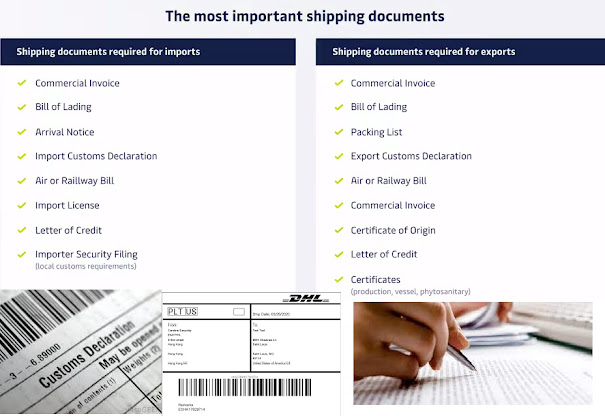
The most important shipping documents

Commercial Invoice: The Commercial Invoice is one of the most important documents when shipping your ocean freight. It is the invoice that is issued by the seller (exporter) to the buyer (importer). It is required in the customs clearance process.


Packing List: The Packing List is another important shipping document when transporting ocean freight internationally. It is a detailed overview of the cargo mentioned on the Commercial Invoice above. It also includes information on how the shipment has been packed and which marks and numbers are noted outside of the shipment boxes.


Export/Import Customs Declaration: An Export or Import Customs Declaration lists details of the goods which are imported or exported. This declaration is especially important when shipping international freight. Describing it in legal terms, with a Customs Declaration a person shows the wish to place goods under a given customs procedure. The Declaration is used for customs clearance and to calculate the duties or taxes applicable to the cargo. It is prepared by a customs broker using the invoice and packing list. At Twill we are here to help you with customs clearance – find out more.


Bill of Lading & Sea Waybill: The Bill of Lading is a detailed document which you will receive from us. It is the transportation contract and important details on the shipment are included in it. It is another relevant part of the ocean freight and proof that the carrier has received the goods from the shipper in good condition. The party holding this document is also the party controlling the cargo.


A Sea Waybill is also a transport contract. However, the Sea Waybill is not needed for cargo delivery and will only be handed out as a cargo receipt. Moreover, a Sea Waybill is not negotiable and cannot be assigned to any third party.


Certificates (production, vessel, phytosanitary)

As a part of important shipping documents and depending on the type of your cargo, you might be asked for one of the following certificates:


Production Certificate: This Certificate relates to the material or types of production using sustainable resources or approved methods (e.g. sustainable wood sources). It is required to be allowed to ship cargo in or out of regions where regulations related to the production may apply.


Vessel Certificate: The main purpose of a Vessel Certificate is to verify the ownership of a vessel. It also provides certain details such as the age and maintenance of the vessel. The certificate is usually requested as part of requirements for the Letter of Credit.


Phytosanitary Certificate: The Phytosanitary Certificate is a document that certifies plant, as well as plant products, are free from regulated pests. It also notes that the cargo conforms with other phytosanitary requirements as specified by the importing country.


Air or Rail Waybill: Depending on your mode of transport, you will get an Air or Rail Waybill. The Air Waybill (AWB) is a non-negotiable document that is issued by an air carrier as an acknowledgement of the possession of a shipment. The AWB is also a type of bill of lading. However, it is issued in a non-negotiable form, so there is less protection with an AWB in comparison to the bill of lading. The AWB also serves as a receipt for the consignor (the shipper). This document shows the shipment’s destination address as well as contact information for the consignor and consignee (the receiver).

In comparison, the Rail Waybill is a document used for shipments via a railway. This document is prepared by the shipping agent or railway line, after receiving the instructions from the shipper.


Arrival Notice: Another important document when shipping is the Arrival Notice or Notice of Arrival.  This document informs that the cargo is arriving at the destination. It includes relevant details such as the commodity description, sailing details, destination country related to customs charges and the contact details of the ocean freight carrier. It is issued by the ocean freight carrier’s destination agent to the consignee and to parties that might be needed to notify as mentioned on the Bill of Lading.


Certificate of Origin:    The Certificate of Origin is the document that declares in which country a good or commodity was manufactured. It is needed on a regular basis. This document contains information about the product, its destination as well as the country of export. It is an important form as it helps to determine if goods are eligible for import if they are subject to duties.


Importer Security Filing (local customs requirements)    : Your shipment might need to require an Importer Security Filing (ISF). This document is a US customs and border protection regulation that only counts for ocean cargo imports. Prior to the shipping order, importers should send the required data for this documentation to their US customs broker, as it is required to be filed with US customs and border protection 24 hours prior to sailing from last origin port. Required data are among other the seller’s and buyer’s name as well as address, the importer of record, the ultimate consignee, manufacturer’s name and address as well as the country of origin.


Letter of Credit    :    A Letter of Credit is a primary means of payment in an international trade transaction. It is by default irrevocable. This document is a promise by a bank on behalf of the buyer (the importer) to the seller (the exporter) with a specified sum in an agreed currency. Moreover, it requires that the seller submits the needed documents at a predetermined deadline. Additionally, it includes information such as the description as well as the quantity of goods, technical description and documentary requirements.